How I Built an Organic Lead Gen Machine: A ₹3 Lakh Case Study
 Aman Suryavanshi
How I Replaced ₹50k/Month Ad Spend with an Automated Next.js Machine (₹3 Lakh Case Study)
Prerequisites To get the most out of this deep dive, you should have a baseline understanding of:
- Next.js 14 (App Router): Server components and API routes.
- Automation Logic: Basic familiarity with webhooks and nodes (n8n/Zapier).
- Headless CMS/DB: Conceptual knowledge of Sanity.io and Firebase.
I’m Aman Suryavanshi, a Product Engineer and Next.js specialist based in Delhi/NCR. I’ve spent the last few years building production-grade automations that don't just "work"—they scale without exploding your cloud bill. This case study details how I built a complete lead-generation engine for Aviators Training Centre (ATC), India's premier DGCA ground school, turning a struggling paid-ad model into a self-sustaining organic revenue stream.
Why is Ad Dependency the "Silent Killer" for Scaling Businesses?
When I first audited Aviators Training Centre, they were trapped in a common "Pay-to-Play" cycle. They were spending ₹35,000–₹50,000 every single month on Facebook Ads just to keep the lights on.
The numbers were grim:
- Cost Per Lead (CPL): ₹500–₹800.
- Organic Presence: Non-existent.
- Admin Overhead: 3–4 hours daily spent manually chasing leads on WhatsApp.
In an era where Customer Acquisition Cost (CAC) is skyrocketing globally, relying 100% on paid traffic is a recipe for razor-thin margins. The client asked a simple question: "Can we stop depending on paid ads?"
My answer was a complete architectural overhaul. We didn't just need a new website; we needed a Full-Stack Revenue Machine.
The Architectural Epiphany: Why I Chose a "Non-Blocking" Stack
Most developers build lead forms that hit a single API and wait. If the CRM is slow or the automation tool hiccups, the user sees a loading spinner—or worse, an error.
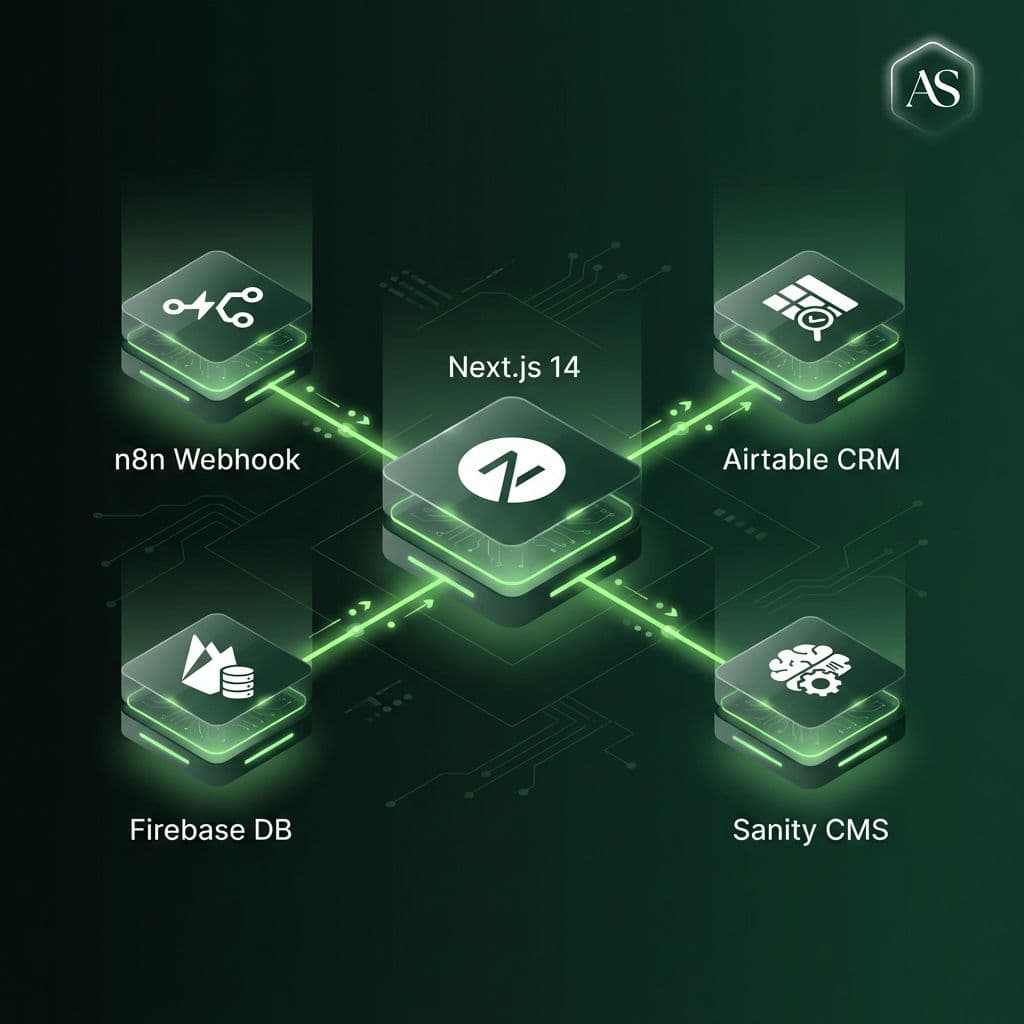
I implemented a non-blocking webhook architecture. When a student submits a form at ATC, the Next.js frontend immediately acknowledges the submission and offloads the processing to a background worker. User experience is protected, and data integrity is guaranteed.
The "Zero-Cost" Infrastructure Stack I had a specific constraint: keep the monthly overhead at ₹0. Here is how I stacked free tiers to build a professional-grade system:
- Frontend: Next.js 14 + Tailwind (Vercel Free Tier).
- Database: Firebase Realtime DB (Zero cost for this scale).
- Automation: n8n (Self-hosted on a home server/low-cost VPS).
- CRM: Airtable (Visual pipeline for the client).
- CMS: Sanity.io (Handling 2,000+ word SEO deep-dives).
- Scheduling: Cal.com (Replacing expensive Calendly subs).
The N x M integration problem disappears when you adopt a centralized automation hub—suddenly, adding 10 new tools takes the same effort as adding 1.
Solving the "Empty Object" Nightmare in n8n
One of the biggest hurdles during development was a ghost in the machine: the n8n Empty Object Bug. About 40% of booking confirmations were arriving in the client's inbox as blank emails.
The Problem: The webhook was firing before the database had finished its write operation, or the JSON payload was malformed during the handshake.
The Solution: I built a 3-layer validation middleware within n8n:
- Schema Check: Does the incoming JSON have the required keys?
- Retry Logic: If data is missing, wait 2 seconds and query the Firebase ID directly.
- Fallback: If all fails, alert the admin via a private Telegram bot instead of sending a blank email to the customer.
Engineering for SEO: The Path to ₹3 Lakh in Organic Revenue
Google doesn't just rank content; it ranks performance. We took the ATC website from a Lighthouse score of <50 to a consistent 95+.
The 5-Part Optimization Sprint:
- Image Genesis: Used Next/Image with WebP conversion, reducing asset sizes by 93%.
- Code Splitting: Leveraged dynamic imports to reduce the initial bundle by 67%.
- Font Strategy: Switched to local self-hosted fonts to eliminate layout shifts (CLS).
- Script Lazy Loading: Third-party tracking scripts only load after the first user interaction.
- Aggressive Caching: Implemented Incremental Static Regeneration (ISR) via Sanity.io webhooks.
The New Reality: Metrics That Matter
After 4 months of running this system, the results shifted from "technical metrics" to "business outcomes":
- Revenue: ₹3,00,000+ (All from organic leads).
- Leads: 50+ high-intent students (vs. low-quality ad leads).
- Conversion Rate: 12% (Industry average is often <5%).
- Admin Time: Reduced from 4 hours/day to 30 minutes/day.
The AI Discovery Factor (GEO) Interestingly, we found that ~15% of our quality leads were coming from AI engines like Perplexity and ChatGPT. By structuring our Sanity.io content with clean schema markup and technical depth, we became a "cited source" for students asking AI about DGCA ground schools in India.
What’s Next for the ATC Platform?
The current system is robust, but the next phase involves Predictive Lead Scoring. I’m working on an n8n node that uses OpenAI to analyze the "message" field in contact forms to prioritize leads based on urgency and intent, automatically moving "hot" leads to the top of the Airtable pipeline.
I used this exact pattern of performance-first engineering in the Aviators Training Centre project, and I'm looking to apply these automation principles to larger-scale SaaS products next.
Let’s Compare Notes: Are you still paying for ads, or have you started building your organic engine? I’m curious to see how others are handling n8n reliability at scale. Let’s connect on LinkedIn and talk shop.
Aman Suryavanshi is a Product Engineer specializing in Next.js and Automation. He builds systems that turn technical debt into revenue-generating assets.

Let's Create Something Amazing Together!
Whether you have a project in mind or just want to connect, I'm always excited to collaborate and bring ideas to life.
Continue the Journey
Thanks for taking the time to explore my work! Let's connect and create something amazing together.